
Cart abandonment at checkout is not a traffic problem. Buyers are already there. The problem is what happens next.
Baymard Institute’s review of 49 studies puts the global average cart abandonment rate at 70.19%. That is not about weak products or bad pricing. Instead, it is checkout friction. The Vancouver 2010 Olympic Store moved from a multi-step layout to a single page and gained 21.8% more conversions. Indeed, research shows one-page checkouts outperform multi-step flows by 7.5% on average.
What drives that improvement? Below are eight specific reasons the One Page Checkout for OpenCart by Knowband closes the conversion gap that multi-step checkouts leave open.
8 Reasons Why One Page Checkout Works
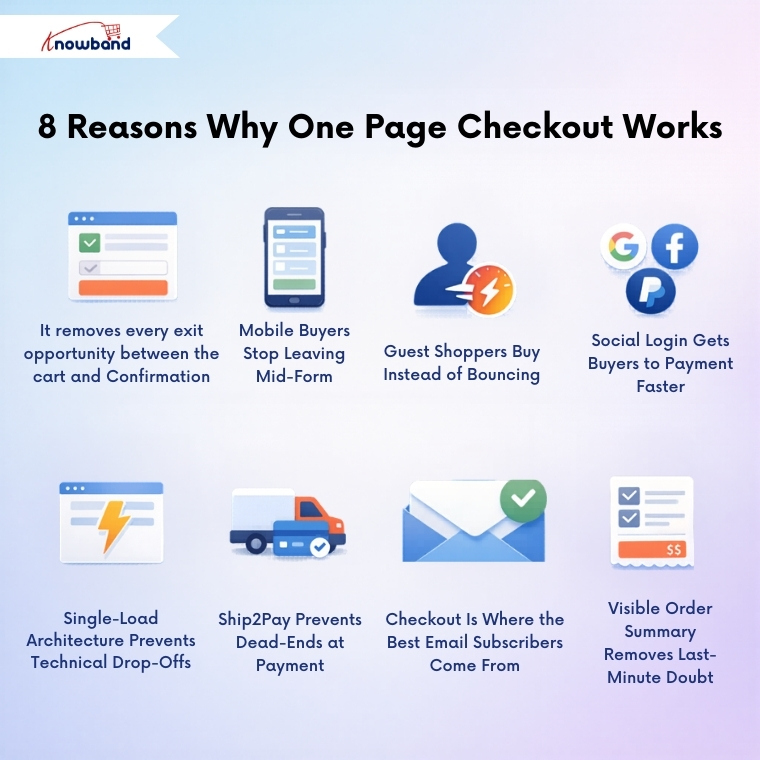
1. It removes every exit opportunity between the cart and Confirmation
Each screen transition in a multi-step checkout gives the buyer a chance to stop, get distracted, or encounter a loading error. Consequently, multi-step flows create dropout risk at every stage. The OpenCart One Page Checkout puts billing, shipping, payment, and order review inside a single pop-up. There is nowhere to navigate away to, and no pause between steps.
2. Mobile Buyers Stop Leaving Mid-Form
Desktop sessions convert at nearly double the rate of mobile, mostly because multi-screen forms are harder to complete on small displays. The OpenCart responsive checkout popup adapts to any screen width. Fields stack cleanly, buttons stay tap-friendly, and the buyer never needs to zoom or scroll sideways. Moreover, social login cuts manual typing to near zero, the friction point that costs most mobile sessions.
3. Guest Shoppers Buy Instead of Bouncing
Forced registration before payment is one of the most commonly cited reasons buyers abandon. A first-time visitor has no reason to create an account under time pressure. The OpenCart fast checkout extension provides a clean guest path, name, email, address, payment, and done. Furthermore, in the final checkout step, customers are given the option to subscribe to newsletters through a clearly presented checkbox, so the store gains the data without the buyer hitting a wall.
4. Social Login Gets Buyers to Payment Faster
Even returning customers abandon when they cannot recall which email they registered with or need to recover a forgotten password. However, one-tap Google, PayPal, and Facebook login inside the One Page Checkout for OpenCart eliminates that. Specifically, returning buyers authenticate in one click, and new buyers pull their details from their social profile. Both reach the payment field in seconds.
5. Single-Load Architecture Prevents Technical Drop-Offs
Every page transition in a multi-step checkout is a technical risk. A server timeout or a brief network interruption can break the session, and that buyer rarely returns. The OpenCart simplified checkout module loads once and stays resident in the browser until payment submission. Therefore, the between-step failures that structurally affect multi-page flows do not occur.
6. Ship2Pay Prevents Dead-Ends at Payment
A buyer who selects a shipping method and then finds incompatible payment options will either hit an error or abandon out of confusion. The Ship2Pay feature inside the OpenCart fast checkout extension automatically matches payment methods to the chosen delivery type. As a result, buyers only see options that work for their order. Hence, dead-ends at the payment screen stop happening.
7. Checkout Is Where the Best Email Subscribers Come From
Signup forms on the homepage or sidebar collect addresses from browsers. The checkout, however, collects them from buyers. The OpenCart One Step Checkout module includes a MailChimp subscription checkbox inside the pop-up itself. Additionally, because the opt-in sits within the purchase flow rather than alongside it, completion rates run higher than standalone forms.
8. Visible Order Summary Removes Last-Minute Doubt
A buyer who cannot see their full order total, shipping cost, and selected delivery method at the payment step will hesitate. Some navigate back to verify. Most do not return. The OpenCart One Page Checkout displays the complete order summary alongside the payment and shipping fields simultaneously. Overall, this removes the uncertainty that causes last-minute abandonment and gives buyers the clarity to confirm.
Features Inside the OpenCart One Page Checkout Module
The module activates as a single pop-up overlay from the cart page. Billing, shipping, payment, and confirmation are all complete within this one layer with no redirects. Generally, guest checkout runs without account creation, and silent auto-registration optionally captures customer data after payment. One-tap Google, PayPal, and Facebook login pre-fills form fields for new and returning buyers. Similarly, Ship2Pay automatically pairs compatible shipping and payment combinations. The OpenCart One Step Checkout module also includes a MailChimp opt-in for in-checkout email capture.
Why These Eight Reasons Matter Commercially
A 1% lift in checkout conversion on a store with 5,000 monthly sessions is revenue that requires no additional traffic spend. Checkout optimization works on buyers who have already decided to purchase. The OpenCart One Page Checkout module by Knowband addresses each failure point documented above. Unlike broader site changes that take months to trace in analytics, checkout simplification produces observable conversion changes within weeks.
Whether a store sells ten products or ten thousand, the buyer’s psychology at checkout follows the same pattern. Fewer obstacles and faster completion produce more confirmed orders. That is what the OpenCart simplified checkout module delivers.
Conclusion
Checkout conversion improvement does not need a site redesign or a new traffic campaign. It needs the removal of specific friction points that stop buyers from finishing what they started.
The OpenCart One Page Checkout module handles all eight: fewer steps, mobile-ready design, guest path, social login, technical reliability, intelligent payment pairing, in-checkout email capture, and order summary clarity. Finally, if your OpenCart store loses buyers at the last step, this is where the fix starts.


