
Etsy’s audience is not shrinking, but the way sellers reach it has changed. Handmade and niche products still move well there, and OpenCart merchants keep asking the same thing before they commit: what actually breaks when you try to run both platforms at once? An Opencart Etsy integration extension is usually the answer, but it’s worth understanding the problems first, since the tool only matters once you know what it’s solving.
Etsy charges a $0.20 listing fee and a 6.5% transaction fee on most orders, on top of payment processing costs. Those numbers matter for margin planning, but they’re not what trips up most OpenCart sellers in their first few months. The real damage happens in inventory sync.
Why Multichannel Selling From OpenCart Creates Inventory Problems
When a store runs on two platforms without a connector, someone has to manually match stock levels after every sale. Miss one update and a product sells on Etsy after it’s already gone on OpenCart, or the reverse. One seller who audited dozens of dual-platform shops found that a store’s Etsy rating dropped from 4.9 to 4.6 stars within two months, entirely from inventory mismatches and the refunds that followed.
That’s not a rare outcome. Multichannel selling without a sync layer works fine at ten products and falls apart at two hundred, just when most merchants start getting meaningful traffic from Etsy.
What to Check Before You Connect Your OpenCart Store to Etsy
Before setting up an Etsy seller account and linking it to OpenCart, you must go through the following points:
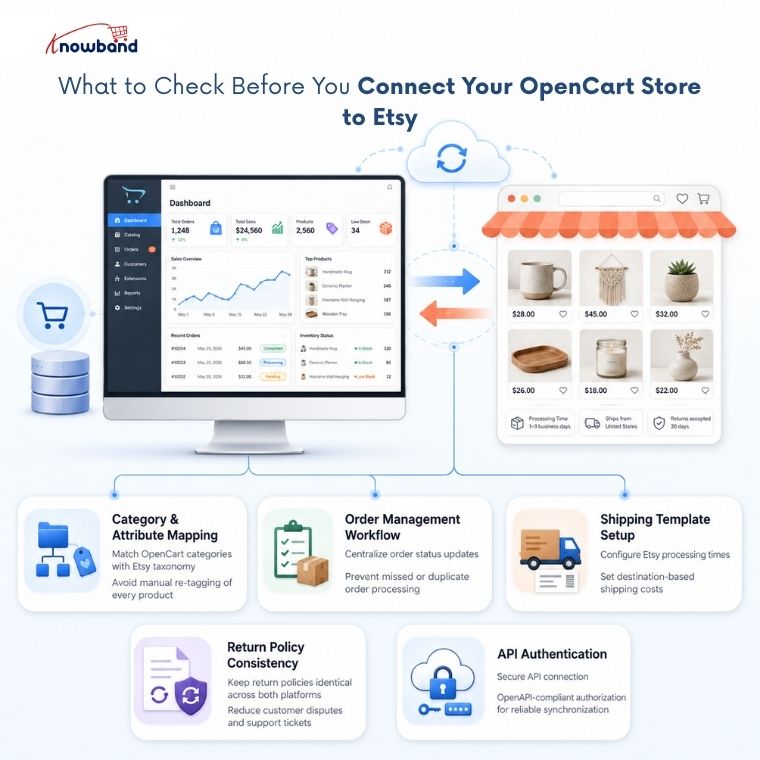
- Category and attribute mapping: Etsy’s taxonomy doesn’t match OpenCart’s categories one for one, so you need a way to map them without manually re-tagging every listing.
- Order management workflow: Decide which dashboard should control order status updates, since running two separate dashboards means someone eventually forgets to update one.
- Shipping template setup: Etsy expects processing times and destination-based costs to be configured per listing, rather than copied from a generic OpenCart shipping rule.
- Return policy consistency: Mismatched return terms across platforms create support tickets and, eventually, complaints.
- API authentication requirements: Etsy’s current API standard requires OpenAPI-compliant authorization headers, and older, non-compliant setups can silently lose connection.
Each of these is a manageable task on its own. Stacked together and handled by hand, they’re where most OpenCart-to-Etsy attempts quietly break down.
Manual Setup vs. an Automated Sync Extension
| Task | Manual Setup | Opencart Etsy Synchronization Extension |
| Stock updates | Done per-platform after each sale | Synced automatically after any OpenCart change |
| Product listing | Uploaded one by one on Etsy | Bulk-listed by category profile |
| Order tracking | Checked in two separate dashboards | Etsy orders imported into the OpenCart admin |
| Category mapping | Re-entered manually per listing | Mapped once per profile, reused |
| Return policies | Set separately on each platform | Synced from OpenCart to Etsy per profile |
The table isn’t theoretical; it reflects the exact tasks store owners describe struggling with in OpenCart and Etsy seller forums, usually after their first stock-mismatch complaint.
The Opencart Etsy Integration Extension That Solves This
This is where Knowband’s OpenCart Etsy Marketplace Integration extension earns its place in the conversation. It’s built specifically around the failure points above.
The module handles profile-level product synchronization, so you can list specific categories on Etsy rather than dumping your entire catalog at once. It also functions as a genuine Opencart Etsy Synchronization Extension for stock: any inventory or attribute change made in OpenCart pushes to Etsy automatically, closing the exact gap that caused that 4.9-to-4.6 rating drop mentioned earlier. Shipping templates and return policies get built once in OpenCart and synced to Etsy per profile, and order status updates flow both directions through scheduled cron jobs rather than manual dashboard-switching.
None of this removes the decision-making covered above; you still need to plan your categories and shipping rules. It just removes the repetitive manual work of keeping two platforms honest with each other.
Deciding If You’re Ready to Sell on Etsy From OpenCart
Etsy remains a strong channel for handmade, vintage, and niche goods in 2026, but the platform rewards sellers who treat Etsy as a dedicated sales channel rather than an occasional listing platform. The considerations above, category mapping, order workflow, shipping templates, return policy consistency, and API compliance, determine whether that second storefront helps you or quietly costs you sales.
An Opencart Etsy Integration Extension turns those considerations from ongoing manual work into a one-time setup. If you’re weighing the move, start with the Opencart Etsy Connector built specifically for this handoff, and confirm it covers your category structure and shipping rules before your first Etsy listing goes live.
For more such reads, you can visit:


